


Va-YSG Medium
Kyokuto Pharmaceutical Indust
- Catalog No.:
- KYO-08901


- Shipping:
- Calculated at Checkout
$309.00
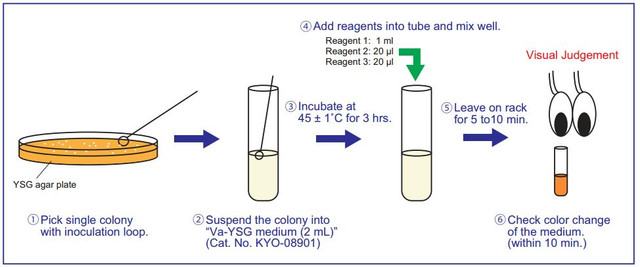
Va-YSG Medium is optimized for use with the Guaiacol Detection Kit (KYO-08921).
Containing yeast extract, glucose, soluble starch and vanillic acid, this low pH medium promotes Alicyclobacilli growth from fruit juices and facilitates their production of guaiacol.
Related Products

Product Description
Va-YSG Medium for guaiacol formation
Va-YSG Medium is optimized for use with the Guaiacol Detection Kit (cat. no. KYO-08921).
Containing yeast extract (for vitamins and growth factors), glucose (as an energy source), soluble starch (for detoxification of metabolic by products) and vanillic acid, this low pH medium promotes Alicyclobacilli growth from fruit juices and facilitates their production of guaiacol.
Components
Va-YSG Medium
Vanillic acid added YSG medium for guaiacol formation 2 mL x 100 tubes
Recommended Companion Products
YSG Agar Plate - 20 plates (Cat. No. KYO-06810)
YSG agar medium for TAB isolation 10 x 2 plates/1 box
Guaiacol Detection Kit – 100 tests (Cat. No. KYO-08921)
Reagent 1: 50mM Potassium Hydrogen Phthalate Buffer 60 mL x 2 bottles
Reagent 2: 1.3 % Hydrogen Peroxide Solution 2.5 mL x 1 tube
Reagent 3: Peroxidase-Phosphoric Acid Buffer 2.5 mL x 1 tube
Positive Control: Guaiacol (1050 ppm) 2.5 mL x 1 tube

Brown color indicates contamination of AAT 1.Negative Control 2. A. acidoterrestris B2067 3. A. acidoterrestris ATCC49025T 4. A. acidocaldarius ATCC27009T 5. A. acidocaldarius HP2 6. A. genomic sp. P2 7. A. genomic sp. DSM11983
References
1.Niwa, M., A. Kawamoto, Development of a rapid detection method of A. acidoterretris, hazardous bacteria to acidic beverage, Fruit Processing, 13,102-107(2003)
2.Niwa, M. ( A course for “ Taxonomy and identification of microorganisms “ 1, Taxonomy and quality of new thermostable acidophile bacteria.) Technical data of soft drinks 2001(1) 9-26(2001)
3.Niwa, M. et.al. (Development of a rapid detection of A. acidoterretris, hazardous bacteria to acidic beverage ) Report of Association for Fruit Juice (531) 23-30
4.Niwa, M. A. Kuriyama, A. acidoterretris RAPID DETECTION KIT, Fruit Processing, 13,328-331(2003)
5.Niwa, M. et.al., Report of Association for Fruit Juice (541)(Sep. 2003), (Proposal for direct detection of A. acidoterretris using peroxidase method)
6.G.Deinhard, et al., Bacillus acidoterrestris sp. nov., a new thermotolerant acidophile isolated from different soils. Syst. Appl. Microbiol. 10, 47-53 (1987)
7.GOTO, M., Spore-forming thermo-acidophilic bacilli of the genus Alicyclobacillus, Bokin Bobai, 28 (8), 499-508 (2000), in Japanese
8.GOTO, K., Lecture on "Classification and identification of microbes" 1. Classification and properties of new thermo-acidophilic bacilli, January 2001 issue of Soft Drink Technical Data, 9-26 (2001), in Japanese
| Documents & Links for Va-YSG Medium | |
| Datasheet | Va-YSG Medium Datasheet |
| Flyer | Guaiacol Detection Kit Flyer |
| Documents & Links for Va-YSG Medium | |
| Datasheet | Va-YSG Medium Datasheet |
| Flyer | Guaiacol Detection Kit Flyer |
| Citations for Va-YSG Medium – 3 Found |
| Roth, Katerina; Tran, Derrick; Joelsson, Adam; Green, Shannon; Snyder, Abigail B. Detection of Alicyclobacillus spp. and Identification of Guaiacol Production Using the GENE-UP® PRO ACB, IFU Method No. 12, and Cosmo Bio Assays. Journal Of Food Protection. 2023;86(8):100114. PubMed |
| Roth, Katerina; Rana, Yadwinder Singh; Worobo, Randy; Snyder, Abigail B. Alicyclobacillus suci produces more guaiacol in media and has duplicate copies of vdcC compared to closely related Alicyclobacillus acidoterrestris. Applied And Environmental Microbiology. 2024; 39382294:e0042224. PubMed |
| Roth, Katerina; Rana, Yadwinder Singh; Daeschel, Devin; Kovac, Jasna; Worobo, Randy; Snyder, Abigail B. Alicyclobacillus mali sp. nov., Alicyclobacillus suci sp. nov. and Alicyclobacillus fructus sp. nov., thermoacidophilic sporeforming bacteria isolated from fruit beverages. International Journal Of Systematic And Evolutionary Microbiology. 2021;71(9) PubMed |
Va-YSG Medium FAQs
Do you also supply Va-YSG (Cat. No. KYO-08901) without vanillic acid? Yes, we can provide YSG medium without vanillic acid upon request. However, additional production time may be required, and the cost may be higher than that of the standard product. Please note that small-batch production may be difficult.
Can I obtain a live organism of either A. acidobacillus or A. acidoterrestris for quality control or validation testing with Guaiacol Detection Kit (Cat. No. KYO-08921)?
Unfortunately, we are unable to provide you with the bacterial strains.
The following guaiacol-producing Alicyclobacillus acidoterrestris strains may be available from culture collections such as ATCC or DSMZ:
----------------------------------------------------------
・ A.acidoterrestris ATCC49025
・ A.acidoterrestris DSM2498
・ A.acidoterrestris DSM3923
・ A.acidoterrestris DSM3924
----------------------------------------------------------
Can Guaiacol Detection Kit (Cat. No. KYO-08921) be used with water samples?
We cannot clearly determine whether Guaiacol Detection Kit is applicable to water samples because no evaluation data are currently available.
However, there is a type of soft drink known as "near water" or "flavored water", which typically consists of flavoring, water, and little or no juice. We have heard that Guaiacol Detection Kit has been tested with these types of beverages. However, no formal validation data are available.
Can Guaiacol Detection Kit (Cat. No. KYO-08921) be used with sugar or fructose samples?
Unfortunately, we do not have experience with guaiacol detection using sugar or fructose samples. However, we can provide a simple protocol modified from the Japanese spore-counting method for the samples.
If you have your own protocol for the pretreatment of bacteriological tests, please use your protocol instead of the "Sample Preparation" procedure described in the protocol.
The protocol includes instructions for preparing YSG liquid medium. If you use the protocol proposed by us, you do not need to use inoculation loops or YSG agar plates.
If the proposed protocol is not suitable for your samples, it may be possible to modify the protocol accordingly.
If you are interested in the protocol, please feel free to contact us.
Can Guaiacol Detection Kit (Cat. No. KYO-08921) be used to detect guaiacol in Mexican salsa with an off-flavor similar to guaiacol? Will the red color of salsa interfere with the assay?
Unfortunately, we do not have experience using Guaiacol Detection Kit with salsa products. However, if you consider the inspection method by yourself, please consider the following points:
1. Solid material in the sample
If Alicyclobacillus acidoterrestris (AAT) is present in the solid portion of the sample, homogenization should be performed to release the microorganisms from the solid material.
2. Influence of polyphenols
Polyphenols inhibit the growth of AAT. Therefore, samples may need to be diluted 20–50 times to detect AAT. Otherwise, detection may not be possible. We do not know the polyphenol content of salsa products; however, tomatoes are known to contain relatively high levels of polyphenols. While a 10-fold dilution is generally used, dilution of salsa samples by more than 20-fold should be considered.
3. Sample viscosity
Viscosity decreases with dilution; therefore, samples should be diluted appropriately. Please determine the dilution ratio with reference to standard microbiological testing procedures rather than protocols specifically designed for thermo-acidophilic, heat-resistant bacteria.
4. Pigment carry-over
When the final peroxidase reaction is performed, pigments carried over from the sample may make interpretation of the results more difficult. However, this is not expected to be a major issue because the sample will be diluted during testing.
5. Other interfering substances
In the final peroxidase reaction, guaiacol produced by AAT, which is responsible for the off-flavor, polymerizes and develops a brown color. Salsa products contain a variety of ingredients and spices. If any of these components inhibit the peroxidase reaction or exhibit peroxidase-like activity that also results in brown coloration, false-positive or false-negative results may occur.
Can Guaiacol Detection Kit (Cat. No. KYO-08921) be used with milk or beer samples? Unfortunately, we do not have any information available regarding usage with milk or beer.
Can Guaiacol Detection Kit (Cat. No. KYO-08921) be used with honey samples? Unfortunately, we do not have any experience with using the kit with honey.
Can Guaiacol Detection Kit (Cat. No. KYO-08921) detect the conversion of ethylvanillin to ethoxyphenol? Does ethoxyphenol cause off-flavor like guaiacol?
Guaiacol Detection Kit provides a colorimetric result in which the presence of guaiacol is detected through the conversion of guaiacol to tetraguaiacol via a peroxidase reaction.
Regarding 2-Ethoxyphenol, it also undergoes a peroxidase reaction and may therefore produce a similar colorimetric result. However, we have not evaluated this and are not aware of any publications confirming this behavior. We could not find any information regarding off-flavor caused by ethoxyphenol in the available chemical substance databases.
How should samples be diluted before testing with Guaiacol Detection Kit (Cat. No.KYO-08921)? Also, what does YSG distilled water mean?
The term "YSG distilled water" in the documentation should be interpreted as "distilled water."
As for the preparation ratio, please refer to the following ratio as a reference, though considering the ratio case by case is strongly recommended.
The appropriate dilution ratio depends on the sample type and Brix value.
As a reference:
(Reference data is from the Japanese Juice Association)
Apple juice concentrate (70°Brix): 10×
Orange juice concentrate (65°Brix): 10×
Red grape juice concentrate (65°Brix): 20–50×
White grape juice concentrate (65°Brix): 20×
Carrot juice concentrate (40°Brix): 10×
Lemon juice concentrate (50°Brix): 10×
Grapefruit juice concentrate (55°Brix): 20×
Peach juice concentrate (55°Brix): 10×
Appropriate dilution should be determined based on sample characteristics.
What is the recommended inoculation method when using Guaiacol Detection Kit (Cat. No. KYO-08921) for TAB testing?
The Japan Fruit Juice Association recognizes the following methods:
1) Pour Plate Method
2) Spread Plate Method with bent glass rod
3) Membrane Filtration (MF) Method
We may be able to recommend the most appropriate method, if you let us know your customer's sample and method of examination. For your information, please let us show the scheme of TAB test which is described in our brochure.
Can I use BAT medium instead of YSG agar with Guaiacol Detection Kit (Cat. No. KYO-08921)? YSG agar is suitable for use with Guaiacol Detection Kit. We recommend using Va-YSG (Cat. No. KYO-08901 ) for the next step after incubation on YSG agar. Guaiacol Detection Kit is based on the protocol of the Japan Fruit Juice Association; therefore, BAT medium is not recommended. Results obtained using BAT medium cannot be guaranteed.
Do you have any accuracy or validation data for Guaiacol Detection Kit (Cat. No. KYO-08921)?
Regarding the accuracy of Guaiacol Detection Kit, the detection manual reviewed by the Japan Fruit Juice Association includes extensive accuracy data. However, the English version of the manual does not contain this information.
For your reference, please refer to the following publication by the developer, Motohiro Niwa:
Niwa M., Kawamoto A. Development of a Rapid Detection Method of A. acidoterrestris, Hazardous Bacteria in Acidic Beverages. Fruit Processing. 2003;13:102-107.
What is the detection limit of Guaiacol Detection Kit (Cat. No. KYO-08921)? Va-YSG (Cat. No. KYO-08901) used in combination with Guaiacol Detection Kit can detect guaiacol at a concentration of 25 ppm.
Do you have any information available regarding false-positive results with Guaiacol Detection Kit (Cat. No. KYO-08921)? If peroxidase or hydrogen peroxide is present in the sample, Guaiacol Detection Kit may produce false-positive results.