

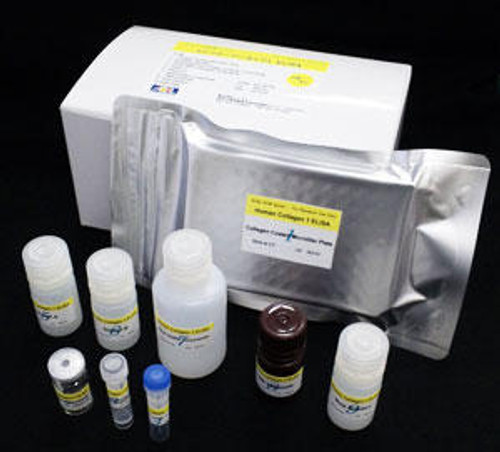
Pepsin for Human Collagen Type I ELISA Kit
ACEL
- Catalog No.:
- ACE-EC1-E110

- Shipping:
- Calculated at Checkout
$174.00
Related Products
When collagen production cell (fibroblast) is cultured in petri-dish, collagen in culture media deposit as ECM. The deposited collagen or tissuecollagen can be eluted by pepsin digestion.
Prepare pepsin solution (Dissolve pepsin powder into 50 mM acetic acid solution to final concentration 0.1 mg/mL).
References
- In Vitro CO-Releasing and antioxidant properties of sulfonamide-based CAI-CORMs in a H2O2-stimulated human achilles tendon-derived cell model. Molecules 2025
- Silencing of ERRα gene represses cell proliferation and induces apoptosis in human skin fibroblasts.
Molecular Medicine Reports 2024 - Snail slime extracted by a cruelty free method preserves viability and controls inflammation occurrence: a focus on fibroblasts. Molecules 2023
- The open cell form of 3D-printed titanium improves osteconductive properties and adhesion behavior of dental pulp stem cells. Materials 2021
- Liposomes embedded with differentiating factors as a new strategy for enhancing DPSC osteogenic commitment.
European Cells & Materials Journal 2021 - Dual acting carbon monoxide releasing molecules and carbonic anhydrase inhibitors differentially modulate inflammation in human tenocytes. Biomedicines 2021
- Bisphosfonate matrix metalloproteinase inhibitors for the treatment of periodontitis: An in vitro study.
International Journal of Molecular Medicine 2018 - Intestinal myofibroblast TRPC6 channel may contribute to stenotic fibrosis in crohn’s disease.
Inflammatory Bowel Diseases 2015 - Differences between protein expression and extracellular matrix state on uniaxial stretching for tenogenic differentiation.
Journal of Mechanics in Medicine and Biology 2014 - Fibroblasts from the growing margin of keloid scars produce higher levels of collagen I and III compared with intralesional and extralesional sites: clinical implications for lesional site-directed therapy.
British Journal of Dermatology 2011
| Documents & Links for Pepsin for Human Collagen Type I ELISA Kit | |
| Datasheet | Pepsin for Human Collagen Type I ELISA Kit Datasheet |
| Documents & Links for Pepsin for Human Collagen Type I ELISA Kit | |
| Datasheet | Pepsin for Human Collagen Type I ELISA Kit Datasheet |
Pepsin for Human Collagen Type I ELISA Kit FAQs
Can this kit be used to measure changes in collagen levels in cultured cells using Human Collagen Type I ELISA Kit (without pepsin: Cat. No. ACE-EC1-E105 / with pepsin: Cat. No. ACE-EC1-E205)? Human Collagen Type I ELISA Kit allows for the measurement of collagen both in culture supernatants and as extracellular matrix.
Does the serum concentration in the culture medium affect the measurement when using Human Collagen Type I ELISA Kit (without pepsin: Cat. No. ACE-EC1-E105 / with pepsin: Cat. No. ACE-EC1-E205)? No. Serum concentration does not influence the measurement based on our internal validation.
What is the range of concentrations that can be measured using Human Collagen Type I ELISA Kit (without pepsin: Cat. No. ACE-EC1-E105 / with pepsin: Cat. No. ACE-EC1-E205)? The detection limits are 0.02 µg/mL at the lower end and 40 µg/mL at the upper end. Since standards of 0.16 to 10 µg/mL are used in actual measurements, this range is recommended.
Can I use Human Collagen Type I ELISA Kit (without pepsin: Cat. No. ACE-EC1-E105 / with pepsin: Cat. No. ACE-EC1-E205) with non-human samples? No. Human Collagen Type I ELISA Kit is specific to human collagen and does not cross-react with the species tested (bovine and chick).
What antibody is used in Human Collagen Type I ELISA Kit (without pepsin: Cat. No. ACE-EC1-E105 / with pepsin: Cat. No. ACE-EC1-E205)? Human Collagen Type I ELISA Kit uses a polyclonal antibody raised against atelocollagen. Because atelocollagen is used as the antigen, the antibody is believed to recognize the triple helix structure.
What is the pH of the "200 mM Tris, 150 mM NaCl solution" used with Human Collagen Type I ELISA Kit (without pepsin: Cat. No. ACE-EC1-E105 / with pepsin: Cat. No. ACE-EC1-E205)? As an example, the pH is approximately 10.5 when the solution is prepared using Tris and NaCl from FUJIFILM Wako Pure Chemical Corporation. pH adjustment is not required.
What is the measurement wavelength for plate readers when using Human Collagen Type I ELISA Kit (without pepsin: Cat. No. ACE-EC1-E105 / with pepsin: Cat. No. ACE-EC1-E205)? The measurement wavelength is 450 nm.
Which cell lines have been used to measure collagen in culture supernatants with Human Collagen Type I ELISA Kit (without pepsin: Cat. No. ACE-EC1-E105 / with pepsin: Cat. No. ACE-EC1-E205)? We have experience measuring collagen in culture supernatants of human dermal fibroblasts and human lung fibroblasts using Human Collagen Type I ELISA Kit.