


Antigen-specific T cells are central to nearly every meaningful immune response. Detecting them, however, particularly at low frequencies in complex biological samples, has always been a challenge. Commonly used assays, such as limiting dilution analysis (LDA), routinely underestimate true T cell numbers by orders of magnitude, while functional assays can miss exhausted or dysfunctional T cells entirely.
Due to these limitations, T cell characterization using soluble MHC monomers has been used, but is often unreliable due to the transient interaction between monomeric MHC-peptide (pMHC) complexes and the T cell receptor (TCR). MHC tetramers solve this problem through direct, specific, and quantitative detection of TCR-pMHC interactions, enabling researchers to visualize rare T cell populations in peripheral blood, tumor microenvironments, and diseased tissues with high sensitivity.
What Are MHC Tetramers and How Do They Work?
The TCR-pMHC interaction is, by design, a fleeting one, and that fundamental biology is exactly what tetramer technology was built to overcome. A T cell receptor recognizes its cognate antigen as a peptide presented by an MHC molecule, but the affinity of that interaction is deliberately weak. A single soluble pMHC complex binds a TCR with a half-life on the order of seconds, making it impossible to capture and label antigen-specific cells reliably.
The tetramer format resolves this through avidity. Four biotinylated pMHC monomers are assembled around a fluorescently labeled streptavidin core, exploiting streptavidin’s four biotin-binding sites to create a multivalent complex (Figure 1a). When this structure engages multiple TCRs simultaneously on the surface of an antigen-specific T cell, the combined avidity of those binding interactions stabilizes the complex well beyond what any single monomer could achieve (Figure 1b). The result is a stable, fluorescently labeled staining reagent that can be detected directly by flow cytometry.
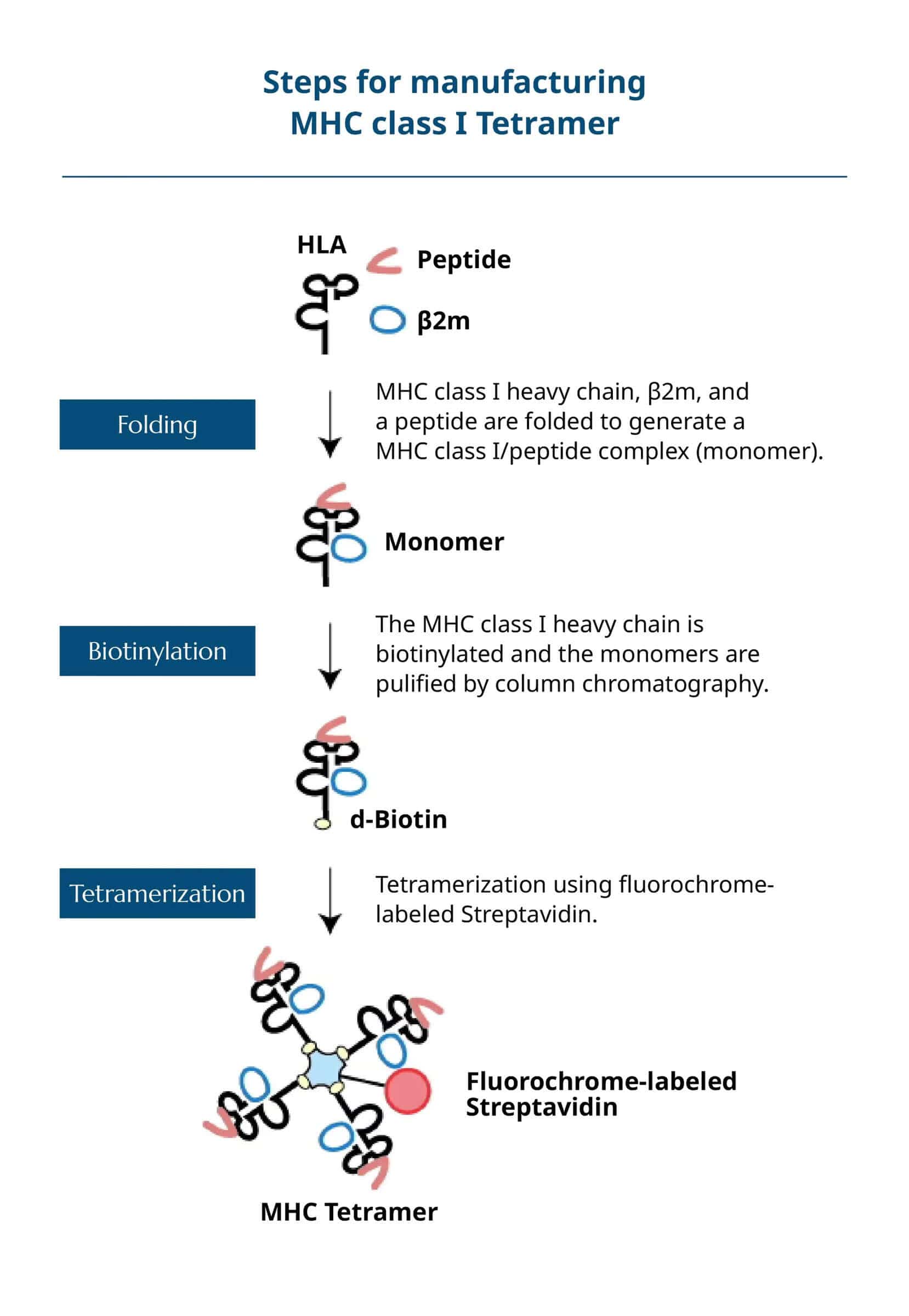 Figure 1. a) MHC tetramer structure with fluorochrome label, b) Three monomers bound to TCR receptors on a cytotoxic lymphocyte, increasing avidity and stability of the binding event.
Comparing MHC Class I and Class II Tetramers
Two distinct classes of MHC molecule, Class I and Class II, are recognized by different T cell species. MHC Class I Tetramers are used to detect CD8+ cytotoxic T lymphocytes (CTLs). Because CD8+ T cells survey virtually all nucleated cells for intracellular antigens — viral proteins, mutant neoantigens, tumor-associated antigens — MHC class I tetramers have broad utility across infectious disease, oncology, and vaccine research.
MHC Class II Tetramers target CD4+ helper T cells, which orchestrate both cellular and humoral immune responses. Because antigen-specific CD4+ T cells exist at low frequencies — often one in 300,000 or fewer — detection requires careful protocol optimization, including in vitro enrichment steps prior to staining.
Why Researchers Rely on Tetramer Staining
The core advantage of tetramer staining over functional assays comes down to what it can detect. Because tetramers bind T cells based on TCR specificity rather than functional output, they detect antigen-specific cells regardless of their activation state, cytokine production capacity, or proliferative potential. Exhausted T cells, common in chronic infection and solid tumors, are difficult to detect with ELISpot and intracellular cytokine staining (ICS), but fully visible to a well-designed tetramer assay. This makes tetramer staining an indispensable complement to functional readouts, not simply a substitute.
Additional practical advantages include:
• Quantitative precision: Tetramer staining integrates directly into standard flow cytometry workflows with reproducible, standardized readouts critical for longitudinal immune monitoring and cross-study comparisons.
• Phenotypic co-staining: Tetramers are fully compatible with antibody panels targeting surface and intracellular markers, allowing simultaneous characterization of differentiation state, activation markers, and effector function.
• Detection of low-frequency populations: MHC tetramers can resolve antigen-specific T cells present at frequencies well below 0.1% of CD8+ T cells in peripheral blood, a level of sensitivity that limiting dilution analysis cannot approach.
How MHC Tetramers Are Advancing Health Science
By understanding the immune response at the TCR-antigen recognition level, researchers can advance discovery across multiple applications:
- Vaccine Development: Monitoring antigen-specific T cell responses is one of the most direct ways to evaluate vaccine immunogenicity. Tetramer staining enables researchers to track expansion, contraction, and memory formation of vaccine-induced T cell populations in both preclinical models and clinical samples.
- Immuno-Oncology: Identifying and characterizing tumor-infiltrating lymphocytes (TILs) with defined antigen specificity is foundational to translational IO research. MHC tetramers can identify tumor-specific CD8+ T cells in peripheral blood and tumor microenvironments, and can track changes in those populations in response to checkpoint inhibitor therapy, cell therapy, or neoantigen-based vaccines.
- Autoimmune Disease Research: Detecting autoreactive T cells, which exist at low frequencies even in affected individuals, requires the sensitivity and specificity that MHC tetramers provide. Tetramer-based immune monitoring is increasingly used to stratify disease risk, monitor disease activity, and assess the impact of immunomodulatory therapies.
- Infectious Disease Monitoring: From HIV and CMV to influenza and SARS-CoV-2, pathogen-specific T cell responses have been characterized using tetramer technology. These assays enable detailed longitudinal tracking of immune responses following infection or vaccination, providing mechanistic insight into protective immunity.
Selecting the Right MHC Tetramer Supplier for Your Research
Through exclusive U.S. distribution by Cosmo Bio USA, researchers now have streamlined access to the Medical & Biological Laboratories (MBL) MHC tetramer portfolio — a performance-validated reagent line built with broad allele coverage and customization capabilities.
MBL MHC tetramers uniquely offer:
- Lower background noise: MBL’s HLA Class I tetramers are engineered with a key point mutation (Ala245Val) at the HLA α3 domain that reduces non-specific CD8 binding while preserving TCR-specific interactions, significantly improving signal-to-noise.
- Broad allele coverage: MBL maintains one of the most comprehensive human MHC Class I tetramer catalogs available, spanning a wide range of HLA supertypes and disease-relevant epitopes. Importantly, this catalog continues to expand with new Class II alleles — a space where coverage has historically been limited across the industry — designed for autoimmunity research, vaccine immunogenicity studies, and infectious disease applications.
- Performance-validated reagents: Each lot is manufactured under rigorous quality control and validated for tetramer staining performance. MBL’s production process includes HPLC monitoring of MHC-peptide refolding and enzymatic biotinylation with BirA, ensuring consistent structural integrity from batch to batch.
- Fluorochrome options: MHC tetramers are available conjugated to PE, APC, FITC, and BV421 providing flexibility across common flow cytometry configurations.
The QuickSwitch™ Platform: Custom Tetramers on Your Timeline
For researchers working with novel epitopes — neoantigens, pathogen variants, or less-characterized alleles — MBL’s QuickSwitch Custom Tetramer Kits offer a purpose-built solution for rapid custom tetramer generation in-house.
QuickSwitch kits ship pre-loaded with a proprietary “exiting peptide” that maintains MHC structural integrity until use. When a researcher adds their experimental peptide alongside MBL’s Peptide Exchange Factor, the exiting peptide is displaced and replaced with the peptide of interest, typically within four hours. The QuickSwitch Quant format includes a FITC-labeled antibody that quantifies exchange efficiency before proceeding to cell staining, ensuring only high-quality tetramers make it to your assay.
Each QuickSwitch kit is optimized for up to ten peptide exchanges, making the platform cost-effective for epitope screening as well as targeted tetramer generation. Peptide exchange, quantification, cell staining, and flow cytometry analysis can all be completed within a single working day.
Key use cases include:
- Neoantigen discovery: Screening candidate peptides from cancer genomes for MHC binding and immunogenicity
- Vaccine epitope mapping: Identifying immunodominant epitopes from complex antigens
- Infectious disease research: Rapidly generating tetramers for emerging pathogen variants
- TCR cloning workflows: Confirming specificity before committing to full custom builds
The QuickSwitch™ Peptide Screening Kit extends this further into high-throughput territory: a 96-well plate format allows same-day screening of overlapping peptide libraries for MHC binding affinity, identifying binders that in silico prediction tools often miss.
Custom MHC Tetramers: Built for Your Research
For projects requiring fully custom tetramer builds — specific peptide-MHC pairings, less-common alleles, or dedicated manufacturing — MBL’s custom tetramer service provides validated reagents tailored to your experimental design. Expert support is available for epitope selection and protocol optimization, particularly valuable for researchers new to tetramer workflows or working with challenging sample types.
Precision Immunology Starts with the Right Tools
Whether you are mapping vaccine responses, characterizing tumor-infiltrating T cells, or investigating autoreactive populations, the ability to directly detect and quantify antigen-specific T cells with TCR specificity is foundational. MHC tetramers have been that foundation for nearly 30 years, and MBL’s MHC tetramer portfolio brings together the breadth of allele coverage, reagent quality, and customization flexibility that rigorous immune monitoring demands.
Cosmo Bio USA is the exclusive U.S. distributor for MBL tetramers and QuickSwitch™ kits, providing U.S.-based researchers with direct access to this portfolio backed by responsive technical support.
Explore MBL MHC Tetramers at Cosmo Bio USA: https://www.cosmobiousa.com/resources/product-insights/mbl-mhc-tetramers
Learn more about MBL International’s full reagent portfolio: https://www.cosmobiousa.com/resources/supplier-spotlights/mbl-international
References
Bousso, P. Generation of MHC-peptide tetramers: a new opportunity for dissecting T-cell immune responses. Microbes and Infection (2000) https://doi.org/10.1016/S1286-4579(00)00324-5